What Is the Battle of Guilford Courthouse and Why Was It Important to the Revolutionary War
On March 15, 1781, a key battle took place near Greensboro. It changed the American fight for freedom forever. This moment is key to understanding the Battle of Guilford Courthouse and its role in the war.
This day was marked by bravery, smart tactics, and great sacrifice. It was a turning point in the fight for freedom.
Looking back at this event, we see the Revolutionary War North Carolina theater more clearly. It made the British army rethink their southern plans. This led to their final defeat.
Studying this battle helps us understand the tough choices that shaped our nation. It’s a key part of American military history.
We invite you to learn about the strategic decisions and brave actions of that day. Knowing this history helps us value the freedom we have today.
The Setting and Strategic Context of the Conflict
After losing big at Saratoga, the British had a new plan for the South. They thought winning the southern colonies would cut off the rebellion and make the rebels give up. This change moved the main fight from the North to the South.
The British thought they’d get lots of support from Loyalists in American Revolution NC. They believed thousands would join the Crown when the British army came. But, this hope was wrong and would trouble them for a long time.
The Southern Campaign of the American Revolution
The Southern Campaign aimed to use local support to bring back royal rule. British leaders wanted to take key ports and then move inland to gain control. They saw American Revolution NC as key to their success.
But, the real situation was much more complicated than they thought. Instead of support, the British found a divided population. This led to many small fights in the countryside.
Tensions Rising in North Carolina
The fight grew fiercer, and North Carolina’s Piedmont became a key battle area. The tough terrain and few settlements made it hard for either side to control everything. The American Revolution NC area forced both armies into risky moves.
The constant troop movements put a lot of pressure on local resources and people. These tensions led to a big fight. By the time they reached the courthouse, the stage was set for a battle that would change history.
Key Figures and Forces at Play
To understand the Guilford Courthouse battle, we must focus on the leaders. They had different ways of fighting, making the battle intense.
Looking at their strategies, we see how they used their resources and troops. This shows us the strategic maneuvering before the battle.
General Nathanael Greene and the Continental Army
General Nathanael Greene led the Southern Department with a clear plan. His Nathanael Greene battle strategy focused on keeping his troops alive, not just winning battles.
He knew he didn’t have to win every fight to win the war. Instead, he used constant movement and smart retreats to weaken the British.
Greene mixed seasoned soldiers with local militia. This flexible force kept him a threat while avoiding army collapse.
Lord Cornwallis and the British Southern Strategy
Lord Cornwallis followed a bold British Southern strategy. He aimed for a decisive victory to end the American rebellion.
Key Guilford Courthouse battle facts show Cornwallis had a smaller but disciplined force. He believed speed and firepower could conquer the Southern wilderness.
The Nathanael Greene battle style frustrated Cornwallis, who often chased a ghost. This led to a fierce battle where both sides were pushed to their limits.
The armies were very different. Cornwallis had professional soldiers, while Greene had a diverse, resilient force. This diversity played a big role in the intense combat.
The Battle of Guilford Courthouse Unfolds
General Greene had a clever plan for the Battle of Guilford Courthouse. He used the North Carolina woods to his advantage. This made the terrain a powerful tool against the British army.
Tactical Deployment on the Field
The American forces spread out wide to block a quick British attack. Greene placed his men to use their muskets well and keep the British guessing. This spacing let the Americans fall back in stages, leading the British into a trap.
The Three Lines of Defense
The battle’s success hinged on Greene’s three-line defense. Each line had a key role in the defense. By making the British fight three times, Greene made them lose many men before facing the last, strongest line.
The First Line: North Carolina Militia
The North Carolina militia stood at the front, behind a rail fence. They fired two volleys and then retreated. This first fight slowed the British and made them reorganize while under fire.
The Second Line: Virginia Militia
The Virginia militia was the second line, 300 yards back. They were more seasoned and fought hard as the British advanced. Their bravery made the battle a long, hard fight for the British.
The Third Line: Continental Regulars
The third line was the strongest, made up of Continental regulars and elite units. These were Greene’s best soldiers, positioned on a hill. According to important Guilford Courthouse battle facts, this line fought with great discipline. They made the British pay dearly for every step they took.
The Brutal Reality of the Fighting
We must look at the harsh reality of the fighting to grasp the true cost of this historic battle. The clash was not just a tactical exercise but a desperate struggle that shaped the American Revolution NC campaign. Soldiers on both sides faced terrible conditions as the battle lines turned into a chaotic melee.
Close-Quarters Combat and Artillery Fire
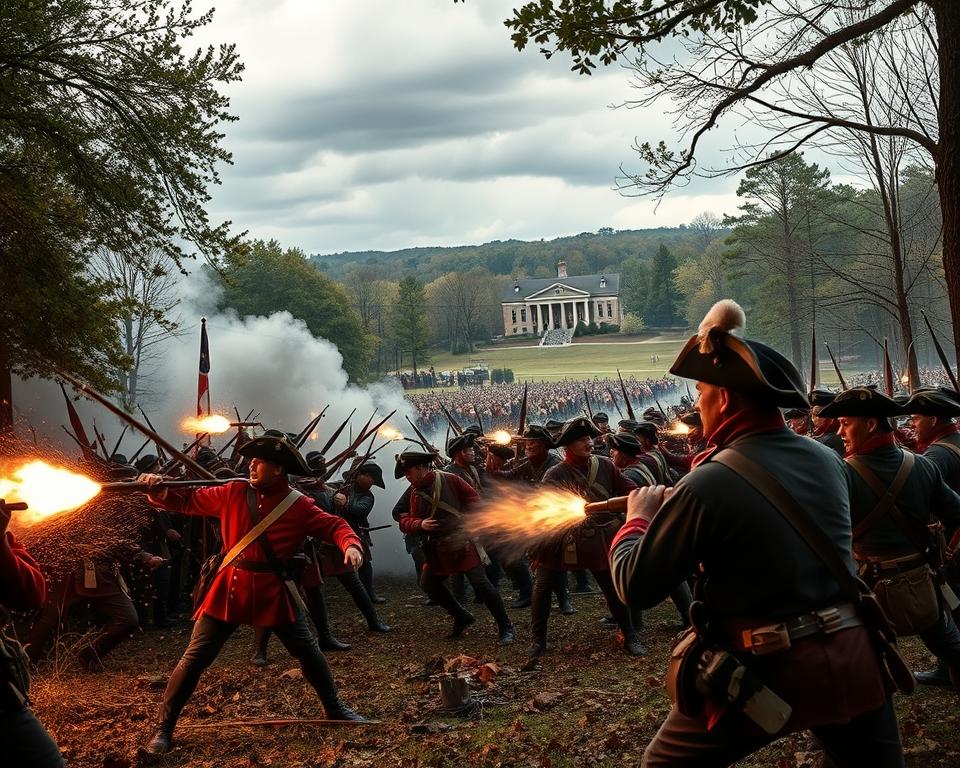
The fighting quickly turned into intense, close-quarters combat. Bayonets and musket butts became the main tools for survival. Lord Cornwallis made a controversial and desperate decision to order his artillery to fire into the thick of the battle. This action hit both American forces and his own men, showing the extreme measures to break the stalemate.
These specific Guilford Courthouse battle facts show the desperation that gripped the British command during the battle. The smoke and noise created a disorienting environment where traditional military discipline often failed. It was a moment of pure survival for every soldier caught in the crossfire.
The Decision to Withdraw
As the situation grew more dire, General Nathanael Greene faced a tough choice. He knew that continuing the fight would likely destroy his army. By choosing to withdraw, he ensured his forces could remain a viable fighting unit for future operations.
This strategic retreat was key for the American Revolution NC’s broader goals. Greene understood that saving his men was more important than holding a single piece of ground. These Guilford Courthouse battle facts show the calculated leadership that allowed the Continental Army to keep going despite heavy losses.
Analyzing the Tactical Outcome
This battle was not a typical win for the British. They controlled the ground at the end, but it cost them dearly. The Nathanael Greene battle strategy made it hard for the British to keep pushing forward.
A Pyrrhic Victory for the British
Many call this a Pyrrhic victory for the British. Lord Cornwallis won the battle, but lost many good soldiers. This strategic failure left the British army short on troops to keep fighting.
The British won the field, but lost control of the area. They were left with a victory that didn’t help them move forward. They couldn’t defeat the Continental Army, leaving them weak and tired.
Casualty Reports and Military Impact
The British took heavy losses in the battle. These losses were hard to replace in the American colonies. The British had to leave their positions soon after the battle.
The Nathanael Greene battle tactics drained the British army, even in victory. This weakened the British in the South. The heavy losses turned a small win into a big loss for the British war effort.
The Strategic Significance for the Revolutionary War
The British position in the South started to fall apart quickly after the battle. They won technically but couldn’t keep the land they fought for. This was a big win for the Americans.
How the Battle Shifting the Momentum
The Nathanael Greene battle was a lesson in wearing down the enemy. Greene made the British use up all their supplies and soldiers. This made it hard for them to control the Revolutionary War North Carolina area.
The British army got more and more isolated as they lost local support. They couldn’t keep the countryside safe, making them easy targets. This showed the British dream of controlling the South was over.
The Road to Yorktown
Cornwallis was in a tough spot after the battle. His army was weak, and his supplies were running low. He decided to retreat to the coast, hoping to find safety and more soldiers in Virginia.
This move led him into a trap. By going to the coast, Cornwallis put his army in a place where they could be surrounded. The Nathanael Greene battle tactics had cornered the British. This led to the surrender at Yorktown.
Reflecting on the Legacy of the Battle
Walking the quiet trails of the historic site where the Battle of Guilford Courthouse took place is deeply meaningful. This landscape is a living classroom for the American Revolution NC story. It reminds us of the heavy price paid for the freedoms we enjoy today.
The National Park Service works hard to preserve these grounds for our benefit. Their dedication ensures that the events of the American Revolution NC remain accessible to everyone. Exploring the physical markers left behind by those who fought here helps us understand our national identity better.
We encourage you to visit this site to experience the history firsthand. Standing on the field allows us to connect with the past in a way that books cannot replicate. The Battle of Guilford Courthouse stands as a testament to the resilience of the human spirit. We invite you to share your thoughts on this moment in our history with others who value our shared heritage.